> For the complete documentation index, see [llms.txt](https://studies-de-jure.gitbook.io/learn/llms.txt). Markdown versions of documentation pages are available by appending `.md` to page URLs; this page is available as [Markdown](https://studies-de-jure.gitbook.io/learn/sourcebooks/business-law-i/common-law-contracts/affirmative-defenses-to-breach-claims.md).
# Affirmative Defenses to Breach Claims
**Affirmative defenses** are "legal" defenses**, which** are distinct from "factual" defenses. A factual defense involves the defendant presenting evidence to establish that they did not commit the actions that the plaintiff alleges. In an **affirmative defense**, the defendant argues that they are not liable, *even if they committed the alleged acts* (such as breaching contractual terms), based on an established legal principle. (For example, an affirmative defense in criminal and tort law that is familiar to much of the general public is self-defense, which is discussed in another section.)
A party may have a valid reason for **breaching**, or not performing, a contract. These reasons are known as defenses to contract. Many of the defenses to contracts go to the heart of whether an agreement ever existed. In other words, if a party does not voluntarily consent or there was no “meeting of the minds,” then a valid contract was never formed.
## Illegality
Illegal contracts are unenforceable because they are void. There are two common types of illegalities: (1) statutory violations, and (2) violations of public policy.
An example of a statutory violation is where a company in the US wants to avoid import regulations and quotas by purchasing Cuban cigars through an intermediary in Mexico. If the US buyer pays the Mexican intermediary for the cigars but does not receive them, the buyer cannot sue the intermediary for breach of contract. The law will not provide a remedy to someone who intends to violate the law.
Examples of violations of public policy often occur in an employment context. An employer that tries to bind its employees to unreasonable non-compete agreements violates the public policy of freedom to work. Another common example is contracts with professionals who do not maintain a current license in their field. If they are not legally licensed for the work they perform, they are not entitled to payment for their services. Here, the public policy is that the law does not want to encourage a black market for services outside of government regulation.
## Incapacity
If someone lacks the mental capacity to understand the terms of the agreement, there cannot be a true meeting of the minds to form a contract. **Capacity** is the mental state of mind sufficient to understand that a contract is made and its legal consequences.
Incapacity can be permanent, such as from mental illness, physical illness, or insanity. Incapacity may also be temporary, such as being intoxicated, under the influence of drugs, or underage (i.e. under eighteen years old).
## Undue Influence
**Undue influence** occurs when one party overpowers the free will of another by use of superior power or influence. In other words, it is unfair persuasion. Undue influence is not a normal level of persuasion. Rather, it occurs when a party agrees to a contract that they would not have otherwise consented to without the unreasonable pressure of the other party. For example, an elderly person who is isolated from others due to poor health and living conditions may be lonely and eager for company. If a caretaker exerted influence over the elder to the extent that he or she could no longer exercise free will, then undue influence occurs. Contracts and transactions in which elders transfer most or all of their wealth to others are frequently reviewed for undue influence.
## Duress
**Duress** occurs when there is a threat to a person, family or property. Economic pressure may constitute duress if it is wrongful and oppressive. Cases involving duress often occur in emergency situations. For example, when someone is required to sign legal paperwork in an emergency room before receiving medical treatment for themselves or their children.
If a person enters into a contract under duress, he or she is able to get out of the contract after the emergency situation is over. Duress essentially overcomes a person’s free will to voluntarily choose to enter into the contract.
## Unconscionability
**Unconscionability** occurs when the contract contains markedly unfair terms against the party with less bargaining power or sophistication than the party who created the terms and induced the other party to sign it. Common cases involving unconscionability claims occur when one party is an experienced business dealer, while the other party is an average consumer. If the business dealer uses a very small font and inserts terms into the contract in a way that intentionally misleads the consumer into signing on unfair terms, then the contract may be deemed unconscionable.
## Statute of Frauds
The **Statute of Frauds** requires the form of certain contracts to be in writing and signed to be enforceable. The Statute of Frauds originated in England in 1677 to prevent fraud when one party tries to claim a contract existed when it did not. The Statute of Frauds requires a written contract for:
1. Real property interests;
2. Marriage;
3. Payment of another’s debt;
4. Contracts that cannot be completely performed within one year;
5. Contracts for the sale of goods of five hundred dollars or more; and
6. Acting as another’s executor/administrator.
## Statute of Limitations
The **statute of limitations** is an affirmative defense that can be raised by a defendant to argue that a lawsuit is being brought too late. This means that if a dispute arises under a contract, then the plaintiff must bring a lawsuit concerning that dispute within a certain time period. States have different statutes of limitations. If a contract has a choice of law provision, then that state’s statute of limitations will apply to disputes related to the contract.
## Mistake
In the context of contracts, a **mistake** is the situation in which the parties did not mean the same thing or when one or both parties formed untrue conclusions about the subject matter of the contract. In other words, a mistake is an erroneous belief.
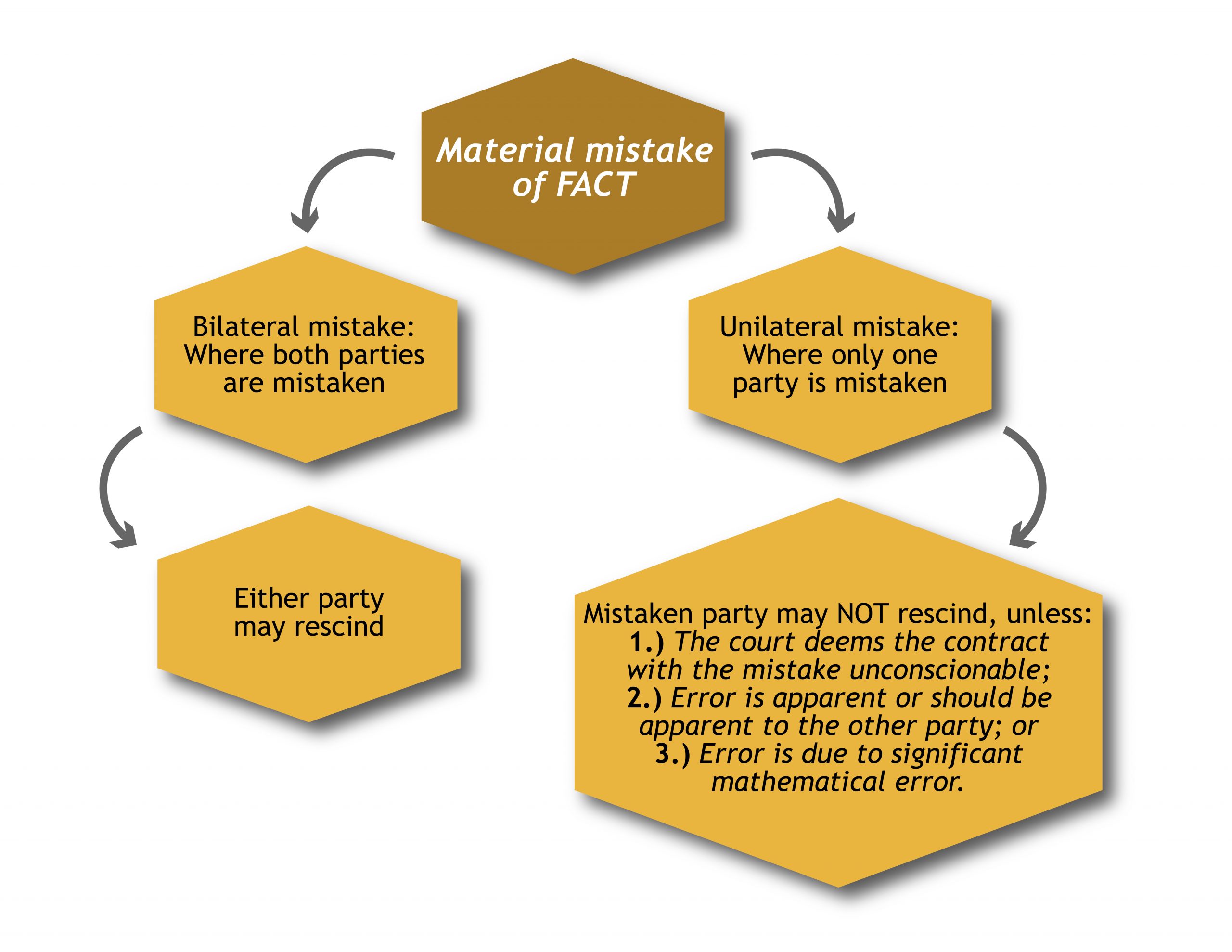
**Mutual mistake** refers to something that is a mistake by both parties that relates to an essential term of the contract. For example, a contract to buy property that is not actually owned by the seller would be a mutual mistake, if the seller believed in good faith that he owned the property. When mutual mistakes occur, either party may rescind the contract.
**Unilateral mistake** occurs when only one party is laboring under a mistake. Mistake does not mean bad bargaining. Courts will not step in to save parties from bad bargaining absent evidence of undue influence or unconscionability. In general, parties cannot rescind the contract when unilateral mistakes occur except when the mistake makes the contract unconscionable, the error is apparent to the other party, or when significant mathematical errors occur.
Types of Mistakes Affecting Contracts and Their Remedies
## Misrepresentation and Fraud
Misrepresentation and fraud are also defenses to contract. **Misrepresentation** is when a party makes a false statement that induces the other party to enter into the contract. **Fraud** is a closely related concept, and it simply means that one party has used deception to acquire money or property. Fraud may also be a basis for criminal charges, depending on the circumstances leading to the contract.
## Commercial impracticability
**Commercial impracticability** is a defense that can be used when fulfilling a contract has become extraordinarily difficult or unfair for one party. For example, a sales contract relating to the sale of goods destroyed by a natural disaster would fall under this defense. It becomes impossible for the seller to deliver goods that no longer exist, and would be unfair to enforce damages against the seller for breach of contract. This is also called **frustration of purpose** or **impossibility** in some jurisdictions.
## Bankruptcy
Sometimes a party to a contract files for **bankruptcy** protection. The bankruptcy court will determine which debts the bankrupt party must pay and which are dischargeable. Contract obligations are suspended temporarily through the bankruptcy court’s automatic stay. In other words, the debt does not have to be paid during the course of the bankruptcy. At the conclusion of the bankruptcy, if the contract obligation is determined to be a dischargeable debt, then the debt will not have to be paid.
***
Attributions and Licensing
* Except where otherwise noted, this page's content is adapted from [Defenses to Contracts](https://pressbooks.pub/introductiontobusinesslaw/chapter/chapter-10/) in [*Fundamentals of Business Law* ](https://pressbooks.pub/introductiontobusinesslaw/)by Melissa Randall (2020), used under [CC BY-NC-SA 4.0](https://creativecommons.org/licenses/by-nc-sa/4.0/).
* The definition of [*affirmative defense*](https://www.law.cornell.edu/wex/affirmative_defense) is derived or otherwise adapted from the [*Wex Legal Encyclopedia* ](https://www.law.cornell.edu/wex)by Cornell Law School Legal Information Institute, under [CC BY-NC-SA 2.5](https://creativecommons.org/licenses/by-nc-sa/2.5/).
This page is licensed under [CC BY-NC-SA 4.0](https://creativecommons.org/licenses/by-nc-sa/4.0/).
---
# Agent Instructions
This documentation is published with GitBook. GitBook is the documentation platform designed so that both humans and AI agents can read, navigate, and reason over technical content effectively. Learn more at gitbook.com.
## Querying This Documentation
If you need additional information that is not directly available in this page, you can query the documentation dynamically by asking a question.
Perform an HTTP GET request on the current page URL with the `ask` query parameter:
```
GET https://studies-de-jure.gitbook.io/learn/sourcebooks/business-law-i/common-law-contracts/affirmative-defenses-to-breach-claims.md?ask=
```
The question should be specific, self-contained, and written in natural language.
The response will contain a direct answer to the question and relevant excerpts and sources from the documentation.
Use this mechanism when the answer is not explicitly present in the current page, you need clarification or additional context, or you want to retrieve related documentation sections.