# Some Basic Contract Terminology

## Relationships Between the Parties

A discussion of contracts will not help much without understanding the relationships between parties to a contract. *Suffixes* (the end syllables of words) in the English language are used to express relationships between parties in legal terminology. In brief, Figure4.1 below lists a few examples of common terms that refer to parties.

<table data-card-size="large" data-view="cards"><thead><tr><th align="center"></th><th></th></tr></thead><tbody><tr><td align="center"><strong>Offers</strong></td><td><p><strong>Offeror:</strong> One who makes an offer</p><p><strong>Offeree:</strong> One to whom an offer is made</p></td></tr><tr><td align="center"><strong>Promises</strong></td><td><strong>Promisor:</strong> One who makes a promise<br><br><strong>Promisee:</strong> One to whom a promise is made</td></tr></tbody></table>

<table data-card-size="large" data-view="cards"><thead><tr><th align="center"></th><th></th><th></th></tr></thead><tbody><tr><td align="center"><strong>Obligations</strong></td><td><strong>Obligor:</strong> One who makes and has an obligation<br><br><strong>Obligee:</strong> One to whom an obligation is made</td><td></td></tr><tr><td align="center"><strong>Transfers of Property</strong></td><td><strong>Transferor:</strong> One who makes a transfer<br><br><strong>Transferee:</strong> One to whom a transfer is made</td><td></td></tr></tbody></table>

## General Attributes of Contracts

Contracts come in both oral and written **forms**. Some contracts are explicit, some not. Because contracts can be formed, expressed, and enforced in a variety of ways, a taxonomy of contracts has developed that is useful in grouping together. In general, a given contract will have four broad descriptive attributes: (1) explicitness, (2) mutuality, (3) enforceability, and (4) degree of completion.

{% hint style="info" %}
📝 **Form** refers to whether the contract is oral or in writing.
{% endhint %}

**Explicitness** is the degree to which the agreement is manifest to those not party to it. **Mutuality** takes into account whether promises are given by two parties or only one. **Enforceability** is the degree to which a given contract is legally binding. **Degree of completion** considers whether the contract is yet to be performed or whether the obligations have been fully discharged by one or both parties. We will examine each of these concepts in turn.

## Explicitness

### Express Contract

An **express contract** is one in which the terms are spelled out directly. The parties to an express contract, whether it is written or oral, are conscious that they are making an enforceable agreement. For example, an agreement to purchase your neighbor’s car for $5,500 and to take title next Monday is an express contract.

### Implied Contract

An implied contract ("implied in fact") is one that is inferred from the actions of the parties. When parties have not discussed terms, an implied contract exists if it is clear from the conduct of both parties that they intended there be one. A delicatessen patron who asks for a turkey sandwich to go has made a contract and is obligated to pay when the sandwich is made. By ordering the food, the patron is implicitly agreeing to the price, whether posted *or not*.

The distinction between express and implied contracts has received a degree of notoriety in the so-called palimony cases, in which one member of an unmarried couple seeks a division of property after a long-standing cohabitation relationship has broken up. When a married couple divorces, their legal marriage contract is dissolved, and financial rights and obligations are spelled out in a huge body of domestic relations statutes and judicial decisions. [No such laws exist](#user-content-fn-1)[^1] for unmarried couples. Although there is no actual contract of marriage (no license), their behavior implies that the parties intended to be treated as if they were married.

### Quasi-Contract

A quasi-contract ("implied in law") is—unlike both express and implied contracts, which embody an actual agreement of the parties—an obligation that a court has “imposed by law” in order to avoid [unjust enrichment](/learn/glossary.md#unjust-enrichment) of one person at the expense of another. So, really, a quasi-contract is not a contract at all; it is a [legal fiction](/learn/glossary.md#legal-fiction) that the courts created to prevent injustice.

Suppose, for example, that the local lumberyard mistakenly delivers a load of lumber to your house, where you are repairing your deck. It was a neighbor on the next block who ordered the lumber, but you are happy to accept the load for free; since you never talked to the lumberyard, you figure you need not pay the bill. Although it is true there is no contract, the law implies a contract for the value of the material: Of course, you will have to pay for what you got and took. The existence of this implied contract does not depend on the intention of the parties.

## Mutuality

### Bilateral Contract

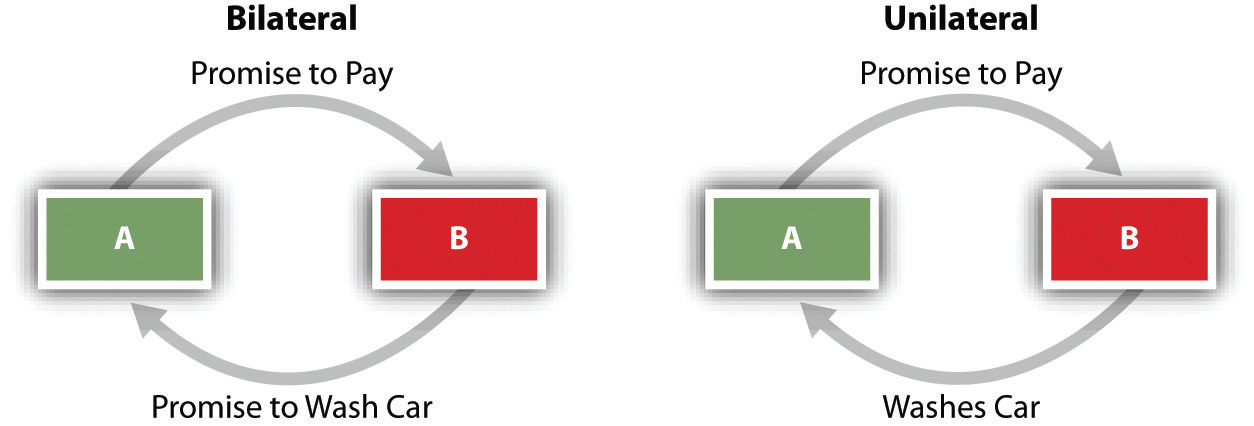
The typical contract is one in which the parties make mutual promises. Each party is both promisor and promisee: Both parties make a promise to the other (to perform an act or refrain from performing an act), and both parties receive a promise from the other. This is called a **bilateral contract**.

### Unilateral Contract

Mutual promises are not necessary to constitute a contract. **Unilateral contracts**, in which one party performs an act in exchange for the other party’s promise, are equally valid. An offer of a reward—for catching a criminal or for returning a lost cat—is an example of a unilateral contract: there is an offer on one side, and the other side accepts by taking the action requested.

<figure><img src="https://2012books.lardbucket.org/books/the-legal-environment-and-foundations-of-business-law/section_11/b6054edf7ae37472dabeb5f7cef774fc.jpg" alt="image demonstrating the difference between bilateral and unilateral contracts"><figcaption><p>Fig. 4.1 Bilateral and Unilateral Contracts</p></figcaption></figure>

## Enforceability

### Void

Remember, not every agreement is a binding contract. An agreement that is lacking one of the legal elements of a contract is said to be a **void** —that is, it is not actually a contract at all. An agreement that is illegal—for example, a promise to commit a crime in return for a money payment—is void. Neither party to a void “contract” may enforce it.

### Voidable

By contrast, a **voidable** contract is one that may become unenforceable by one party but can be enforced by the other. For example, a minor (any person under eighteen, in most states) may “avoid[^2]” a contract with an adult; the adult may not enforce the contract against the minor if the minor refuses to carry out the bargain. But the adult has no choice if the minor wishes the contract to be performed. (A contract may be voidable by both parties if both are minors.)

Ordinarily, the parties to a voidable contract are entitled to be restored to their original circumstances prior to entering into the contract. Suppose you agree to buy your seventeen-year-old neighbor’s car. They deliver it to you in exchange for your agreement to pay them next week. They have the legal right to terminate the deal and recover the car, in which case you will of course have no obligation to pay them. If you have already paid, they still may legally demand a return to the *status quo ante* (previous state of affairs). You must return the car, and they must return the cash.

A voidable contract remains a valid contract until it is voided. Thus, a contract with a minor remains in force unless the minor decides they do not wish to be bound by it. When the minor reaches majority, they may [ratify](/learn/glossary.md#ratify) the contract—that is, agree to be bound by it—in which case the contract will no longer be voidable and will thereafter be fully enforceable.

### Unenforceable

An **unenforceable** contract is one that some rule of law bars a court from enforcing. For example, Tom owes Pete money, but Pete has waited too long to collect it, and the statute of limitations has run out. The contract for repayment is unenforceable, and Pete is out of luck, unless Tom makes a new promise to pay or actually pays part of the debt. (However, if Pete is holding collateral as security for the debt, he is entitled to keep it; not all rights are extinguished because a contract is unenforceable.) A debt becomes unenforceable, too, when the debtor declares bankruptcy.

A bit more on enforceability is in order. A promise or what seems to be a promise is usually enforceable only if it is otherwise embedded in the elements necessary to make that promise a contract. Those elements are mutual assent, real assent, consideration, capacity, and legality.

Sometimes, though, someone says something that seems like a promise, and then the "promisee" relies on it. In the early twentieth century, courts began, in some circumstances, to recognize that insisting on the existence of the traditional elements of contract to determine whether a promise is enforceable could work an injustice where the "promisee" justifiably (i.e., reasonably) relies on the "promise" to their detriment. Thus developed the equitable doctrine of promissory estoppel, which has become an important adjunct to contract law. The [*Restatement* ](/learn/glossary.md#restatement-s-of-the-law)*of Contracts* puts it this way:

> “A promise which the promisor should reasonably expect to induce action or forbearance on the party of the promisee or a third person and which does induce such action or forbearance is binding if injustice can be avoided only by enforcement of the promise. The remedy granted for breach may be limited as justice requires.”\*

{% hint style="info" %}
📌 To be “estopped” means to be prohibited from denying the validity of a promise you made previously.
{% endhint %}

## Degree of Completion

An agreement consisting of a set of promises is called an executory contract before any promises are carried out. Most executory contracts are enforceable. If John makes an agreement to deliver wheat to Humphrey and does so, the contract is called a partially executed contract: one side has performed, the other has not. When John pays for the wheat, the contract is fully performed. A contract that has been carried out fully by both parties is called an executed contract.

{% hint style="success" %}
**‍🔑 KEY TAKEAWAYS**

✔ A given contract has different attributes

* **Explicitness.** The contract will be considered a/an:
  * Express contract
  * Implied contract (i.e., implied in fact); or
  * Quasi-contract (i.e., implied in law).
* **Mutuality.** The contract will be considered a:
  * Bilateral contract; or
  * Unilateral contract.
* **Enforceability.** The contract will be:
  * Enforceable (satisfies all of the required elements of a contract);
  * Void (fails to satisfy at least one of the required elements of a contract);
  * Voidable (enforceable but one or both parties may choose to void it, rendering it unenforceable); or
  * Unenforceable (if not void or voided, a legal rule prevents a court from enforcing it).
* **Degree of Completion.** The contract will be:
  * Executory (the parties have not started performing their promises);
  * Partially executed (one or more parties have started performing a promise but at least one party has not fully performed); or
  * Executed (both parties have completed performing their promises).
    {% endhint %}

***

<details>

<summary>Attributions and Licensing</summary>

Except where otherwise noted, this page's content is adapted from: [Basic Taxonomy of Contracts](https://2012books.lardbucket.org/books/the-legal-environment-and-foundations-of-business-law/s11-03-basic-taxonomy-of-contracts.html) in [*The Legal Environment and Foundations of Business Law*](https://2012books.lardbucket.org/books/the-legal-environment-and-foundations-of-business-law/index.html) by Mayer, D., Warner, D. M., Siedel, G. J., Lieberman, J. K., & Martina, A. R., used under [CC BY-NC-SA 4.0](https://creativecommons.org/licenses/by-nc-sa/4.0/). <img src="/files/pPi3atcoqT9rA4kTq80x" alt="" data-size="line">

This page is licensed under [CC BY-NC-SA 4.0](https://creativecommons.org/licenses/by-nc-sa/4.0/). <img src="/files/pPi3atcoqT9rA4kTq80x" alt="" data-size="line">

</details>

[^1]: However, about one-third of the states recognize common-law marriage, under which two people are deemed to be married if they live together with the intent to be married, regardless of their failure to have obtained a license or gone through a ceremony.

[^2]: In the context of contracts with minors, terms like "avoid" and "disaffirm" refer to a minor voiding the contract.


---

# Agent Instructions
This documentation is published with GitBook. GitBook is the documentation platform designed so that both humans and AI agents can read, navigate, and reason over technical content effectively. Learn more at gitbook.com.

## Querying This Documentation
If you need additional information that is not directly available in this page, you can query the documentation dynamically by asking a question.

Perform an HTTP GET request on the current page URL with the `ask` query parameter:

```
GET https://studies-de-jure.gitbook.io/learn/sourcebooks/business-law-i/common-law-contracts/basic-terms.md?ask=<question>
```

The question should be specific, self-contained, and written in natural language.
The response will contain a direct answer to the question and relevant excerpts and sources from the documentation.

Use this mechanism when the answer is not explicitly present in the current page, you need clarification or additional context, or you want to retrieve related documentation sections.
