# 11.4: Crimes That Invade or Damage Property

1. Last updated
2. [Save as PDF](https://biz.libretexts.org/@api/deki/pages/135388/pdf/11.4%3A%2bCrimes%2bThat%2bInvade%2bor%2bDamage%2bProperty.pdf)

* Page ID135388
* ![](https://math.libretexts.org/@api/deki/files/77648/mini_logo.png)
* Anonymous
* LibreTexts

**Learning Objectives**

1. Define the criminal act element required for burglary.
2. Define the criminal intent element required for burglary.
3. Define the attendant circumstances required for burglary.
4. Analyze burglary grading.
5. Define the elements of criminal trespass, and analyze criminal trespass grading.
6. Define the criminal act element required for arson.
7. Define the criminal intent element required for arson.
8. Define the attendant circumstances required for arson.
9. Define the harm element required for arson.
10. Analyze arson grading.
11. Define the elements of criminal mischief, and analyze criminal mischief grading.

### Burglary <a href="#burglary-17532" id="burglary-17532"></a>

Although **burglary** is often associated with theft, it is actually an enhanced form of trespassing. At early common law, burglary was the invasion of a man’s castle at nighttime, with a sinister purpose. Modern jurisdictions have done away with the common-law attendant circumstances and criminalize the unlawful **entry** into almost *any structure* or *vehicle*, at *any time* of day. Burglary has the elements of criminal act, criminal intent, and attendant circumstances, as is explored in Section 11.3.1 "Burglary".

### Burglary Act <a href="#burglary_act-17532" id="burglary_act-17532"></a>

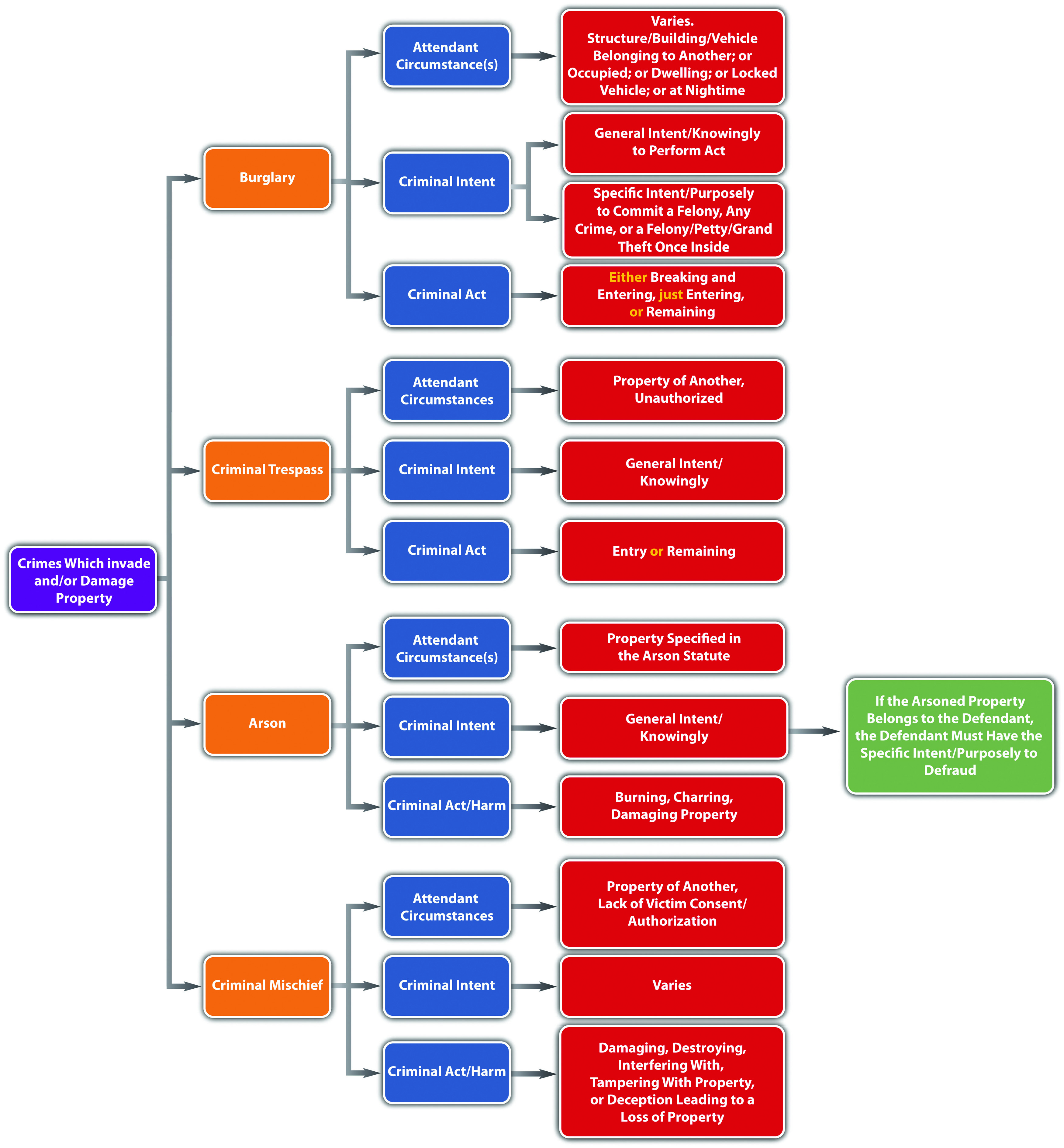
The **criminal act** element required for burglary varies, depending on the jurisdiction. Many jurisdictions require breaking and entering into the area described in the burglary statute.Mass. Gen. Laws ch. 266 § 14, accessed March 20, 2011, <http://law.justia.com/codes/massachusetts/2009/PARTIV/TITLEI/CHAPTER266/Section14.html>. Some jurisdictions and the Model Penal Code only require entering (Model Penal Code § 221.1). Other jurisdictions include **remaining** in the criminal act element.Fla. Stat. Ann. § 810.02(b) (2), <http://law.justia.com/codes/florida/2010/TitleXLVI/chapter810/810_02.html>.

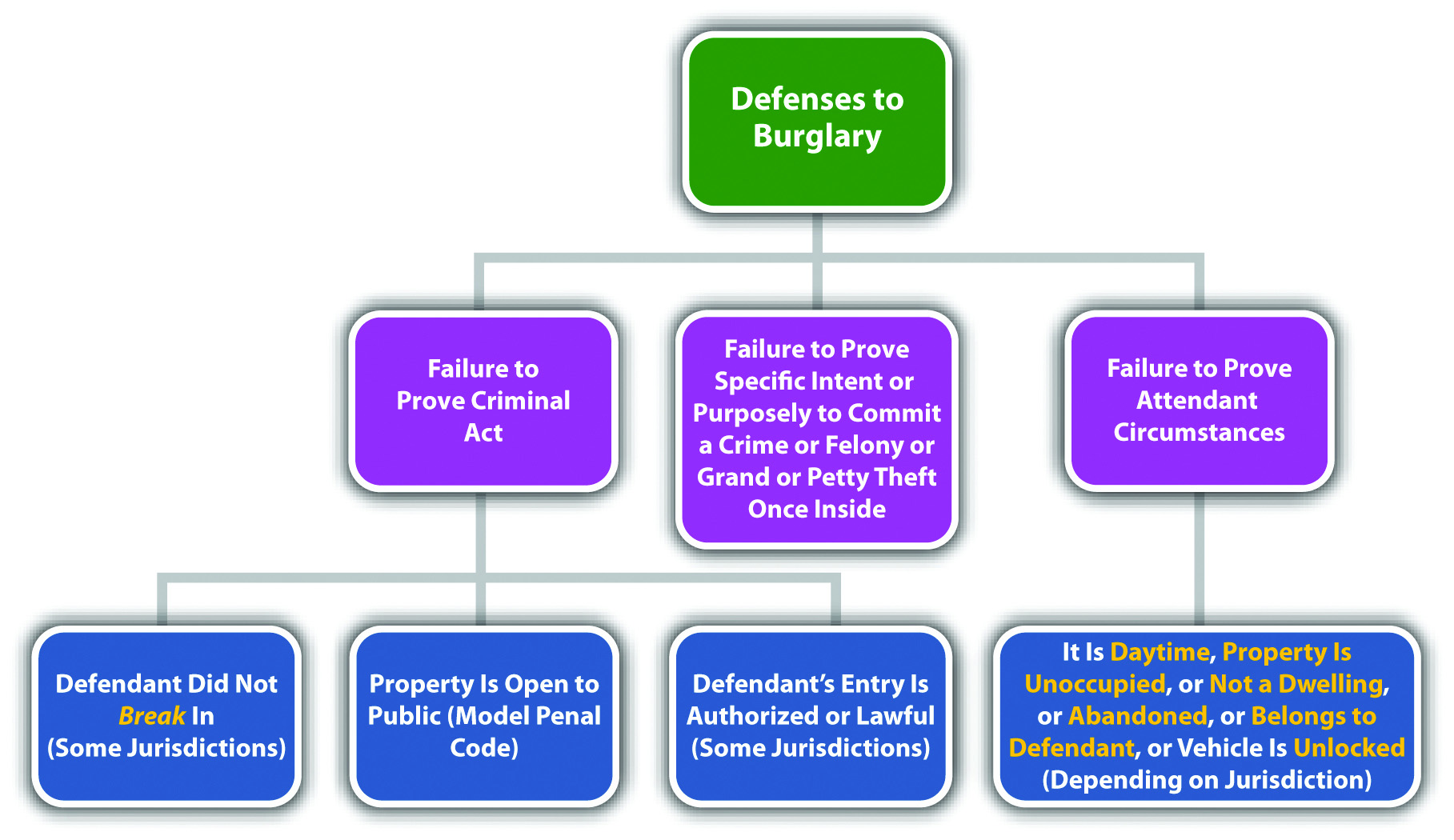
When criminal breaking is required, generally *any* physical force used to enter the burglarized area is sufficient—even pushing open a closed door.*Commonwealth v. Hallums*, 61 Mass. App. Ct. 50 (2004), accessed March 20, 2011, [http://scholar.google.com/scholar\_case?case=5153605963860010581\&q= burglary+%22breaking+requirement%22\&hl=en\&as\_sdt=2,5\&as\_ylo=2000](http://scholar.google.com/scholar_case?case=5153605963860010581\&q=burglary+%22breaking+requirement%22\&hl=en\&as_sdt=2,5\&as_ylo=2000). **Entry** is generally partial or complete intrusion of either the defendant, the defendant’s body part, or a tool or instrument.*People v. Nible*, 200 Cal. App. 3d 838 (1988), accessed March 20, 2011, [http://scholar.google.com/scholar\_case?case=2854983864809427191\&q= burglary+%22partial+entry%22\&hl=en\&as\_sdt=2,5\&as\_ylo=2000](http://scholar.google.com/scholar_case?case=2854983864809427191\&q=burglary+%22partial+entry%22\&hl=en\&as_sdt=2,5\&as_ylo=2000). In some jurisdictions, the entry must be *unauthorized*,*State v. Hall*, 3 P.3d 582 (2000), accessed March 20, 2011, [http://scholar.google.com/scholar\_case?case=14296917791490578337\&q= burglary+%22shoplifting%22\&hl=en\&as\_sdt=2,5\&as\_ylo=2000](http://scholar.google.com/scholar_case?case=14296917791490578337\&q=burglary+%22shoplifting%22\&hl=en\&as_sdt=2,5\&as_ylo=2000). while in others, it could be *lawful*.*People v. Nunley*, 168 Cal. App. 3d 225 (1985), accessed March 20, 2011, [http://scholar.google.com/scholar\_case?case=13700546275600703774\&q= burglary+%22shoplifting%22\&hl=en\&as\_sdt=2,5\&as\_ylo=2000](http://scholar.google.com/scholar_case?case=13700546275600703774\&q=burglary+%22shoplifting%22\&hl=en\&as_sdt=2,5\&as_ylo=2000). The Model Penal Code makes an exception for “premises…open to the public” or when the defendant is “licensed or privileged to enter” (Model Penal Code § 221.1(1)). **Remaining** means that the defendant lingers in the burglarized area after an initial lawful or unlawful entry.*State v. Allen*, 110 P. 3d 849 (2005), accessed March 20, 2011, [http://scholar.google.com/scholar\_case?case=837948213995751444\&q= burglary+%22remaining+means%22\&hl=en\&as\_sdt=2,5\&as\_ylo=2000](http://scholar.google.com/scholar_case?case=837948213995751444\&q=burglary+%22remaining+means%22\&hl=en\&as_sdt=2,5\&as_ylo=2000).

### Example of Burglary Act <a href="#example_of_burglary_act-17532" id="example_of_burglary_act-17532"></a>

Jed uses a burglar tool to remove the window screen of a residence. The window is open, so once Jed removes the screen, he places both hands on the sill, and begins to launch himself upward. The occupant of the residence, who was watching Jed from inside, slams the window down on Jed’s hands. Jed has probably committed the criminal act element required for burglary in many jurisdictions. When Jed removed the window screen, he committed a **breaking**. When Jed placed his hands on the windowsill, his fingers intruded into the residence, which satisfies the **entry** requirement. Thus Jed may be subject to a prosecution for burglary rather than *attempted* burglary, even though he never actually damaged or broke the barrier of the residence or managed to gain complete access to the interior.

### Burglary Intent <a href="#burglary_intent-17532" id="burglary_intent-17532"></a>

Depending on the jurisdiction, the criminal intent element required for burglary is typically the **general intent** or **knowingly** to commit the criminal act, with the **specific intent** or **purposely** to commit a felony,Mass. Gen. Laws ch. 266 § 14, accessed March 20, 2011, <http://law.onecle.com/massachusetts/266/14.html>. any crime,Connecticut Criminal Jury Instructions §53a-102, accessed March 20, 2011, [www.jud.ct.gov/ji/criminal/part9/9.2-3.htm](http://www.jud.ct.gov/ji/criminal/part9/9.2-3.htm). or a felony, grand, or petty theft once inside the burglarized area.Cal. Penal Code § 459, accessed March 20, 2011, <http://law.onecle.com/california/penal/459.html>. The Model Penal Code describes the criminal intent element as “purpose to commit a crime therein” (Model Penal Code § 221.1(1)).

### Example of a Case Lacking Burglary Intent <a href="#example_of_a_case_lacking_burglary_intent-17532" id="example_of_a_case_lacking_burglary_intent-17532"></a>

Hans dares Christian to break into a house in their neighborhood that is reputed to be “haunted.” Christian goes up to the front door of the house, shoves it open, steps inside the front hallway, and then hurriedly dashes back outside. Christian probably does not have the criminal intent element required for burglary in this scenario. Although Christian committed the criminal act of breaking and entering, Christian did not have the intent to commit a crime once inside. Christian’s conduct is probably criminal, but it is most likely a **criminal trespass**, *not* **burglary**. Criminal trespass is discussed in Section 11.3.2 "Criminal Trespass".

### Burglary Attendant Circumstances <a href="#burglary_attendant_circumstances-17532" id="burglary_attendant_circumstances-17532"></a>

Depending on the jurisdiction, burglary often includes the **attendant circumstance** that the area entered is a structure, building, or vehicle belonging to another.Oklahoma Uniform Jury Instructions No. CR 5-13, accessed March 20, 2011, <http://www.okcca.net/online/oujis/oujisrvr.jsp?oc=OUJI-CR%205-13>. However, modern jurisdictions have eliminated the requirement that the property belong to anotherCal. Penal Code § 459, accessed March 20, 2011, <http://law.onecle.com/california/penal/459.html>. and prohibit burglarizing property owned by the *defendant*, such as a landlord burglarizing a tenant’s apartment. Some jurisdictions require a structure or building to be occupied,Iowa Code § 713.1, accessed March 20, 2011, coolice.legis.state.ia.us/cool-ice/default.asp?category=billinfo\&service=iowacode\&ga=83\&input=713. or require it to be a dwelling,Connecticut Criminal Jury Instructions §53a-102, accessed March 20, 2011, [www.jud.ct.gov/ji/criminal/part9/9.2-3.htm](http://www.jud.ct.gov/ji/criminal/part9/9.2-3.htm). and require a vehicle to be *locked*.Cal. Penal Code § 459, accessed March 20, 2011, <http://law.onecle.com/california/penal/459.html>. A few jurisdictions also retain the common-law attendant circumstance that the burglary take place at nighttime.Mass. Gen. Laws ch. 266 § 15, accessed March 20, 2011, <http://law.onecle.com/massachusetts/266/15.html>.

Structure or building generally includes a house, room, apartment, shop, barn, or even a tent.Cal. Penal Code § 459, accessed March 20, 2011, <http://law.onecle.com/california/penal/459.html>. The Model Penal Code expressly excludes *abandoned* structures or buildings (Model Penal Code § 221.1(1)). A dwelling is a building used for lodging at night.Connecticut Criminal Jury Instructions §53a-102, accessed March 20, 2011, [www.jud.ct.gov/ji/criminal/part9/9.2-3.htm](http://www.jud.ct.gov/ji/criminal/part9/9.2-3.htm). Occupied means that the structure or building can be used for business or for lodging at night and does not necessarily require the actual presence of a person or victim when the criminal act takes place.Iowa Code § 702.12, <http://search.legis.state.ia.us/nxt/gateway.dll/ic?f=templates&fn=default.htm>. Nighttime means the time after sunset and before sunrise when it is too dark to clearly see a defendant’s face.*State v. Reavis*, 700 S.E.2d 33 (2010), accessed March 20, 2011, [http://scholar.google.com/scholar\_case?case=10817450688281022337\&q= burglary+%22definition+of+nighttime%22\&hl=en\&as\_sdt=2,5\&as\_ylo=2000](http://scholar.google.com/scholar_case?case=10817450688281022337\&q=burglary+%22definition+of+nighttime%22\&hl=en\&as_sdt=2,5\&as_ylo=2000).

### Example of Burglary Attendant Circumstances <a href="#example_of_burglary_attendant_circumstances-17532" id="example_of_burglary_attendant_circumstances-17532"></a>

Susan breaks down a door and steps inside a building with the intent to commit arson, a felony, once inside. If the building is an empty child’s tiny plastic playhouse, the attendant circumstance that the structure be **occupied** or a **dwelling** is lacking. If it is twelve noon, the attendant circumstance that the criminal act takes place at **nighttime** is lacking. If it is pitch black outside and 10 p.m. and the building is Susan’s ex-boyfriend’s residence, then Susan has most likely committed burglary and may be subject to prosecution for and conviction of this offense.

<figure><img src="https://biz.libretexts.org/@api/deki/files/8765/8a8e524b52d49835a3c70ab420cb7870.jpg?revision=1" alt="Flowchart showing a hierarchy titled Indications for Acyclovir. It branches into Infants and Children &#x26; Adolescents, detailing various medical indications and circumstances below each category."><figcaption><p>Figure 11.8 Diagram of Defenses to Burglary</p></figcaption></figure>

### Burglary Grading <a href="#burglary_grading-17532" id="burglary_grading-17532"></a>

Burglary is typically divided into degrees.Iowa Code §§ 713.3, 713.5, 713.6A, accessed March 20, 2011, coolice.legis.state.ia.us/cool-ice/default.asp?category=billinfo\&service=iowacode\&ga=83\&input=713. First-degree burglary is generally a serious felony that can serve as the predicate felony for first-degree felony murderCal. Penal Code § 189, accessed March 20, 2011, <http://law.onecle.com/california/penal/189.html>. and a strike in states that have three strikes statutes.Cal. Penal Code § 1192.7, accessed March 21, 2011, <http://law.onecle.com/california/penal/1192.7.html>. Factors that can elevate burglary grading are the use or possession of a weapon, the entry into a residence, dwelling, or building where people are present, the commission of burglary at nighttime, or the infliction of injury or death.Mass. Gen. Laws ch. 266 § 14, accessed March 20, 2011, <http://law.onecle.com/massachusetts/266/14.html>. Second- and third-degree burglary generally are still felonies, although less serious than first-degree burglary.Ala. Code § 13A-7-7, accessed March 20, 2011, law\.onecle.com/alabama/criminal-code/13A-7-7.html. The Model Penal Code grades burglary as a felony of the second degree if perpetrated in the dwelling of another at night, or if the actor purposely, knowingly, or recklessly inflicts or attempts to inflict bodily injury or is armed with explosives or a deadly weapon. Otherwise, the Model Penal Code grades burglary as a felony of the third degree (Model Penal Code § 221.1(2)).

Keep in mind that a defendant can be prosecuted for burglary even if the felony or crime intended after entry *never takes place*. In addition, if the defendant actually commits the felony or crime after entry, the defendant can be prosecuted for *both* burglary and the completed crime without violating the protection against double jeopardy in the Fifth Amendment to the federal Constitution. The Model Penal Code states that a “person may not be convicted both for burglary and for the offense which it was his purpose to commit after the burglarious entry…unless the additional offense constitutes a felony of the first or second degree” (Model Penal Code § 221.1(3)).

### Criminal Trespass <a href="#criminal_trespass-17532" id="criminal_trespass-17532"></a>

As stated previously, **criminal trespass** is generally charged when one or more of the attendant circumstances of burglary are lacking or when the criminal intent is less heinous. Typically, criminal trespass is an unauthorized (**attendant circumstance**) entry or remaining (**criminal act**) into a building, occupied structure, or place as to which notice against trespassing is given, owned by another (**attendant circumstance**), with **general intent** or **knowingly** that the entry was unauthorized (criminal intent).18 Pa. C.S. § 3503, accessed March 20, 2011, law\.onecle.com/pennsylvania/crimes-and-offenses/00.035.003.000.html. The Model Penal Code states that it is criminal trespass when the defendant “knowing that he is not licensed or privileged to do so…enters or surreptitiously remains in any building or occupied structure…or any place as to which notice against trespass is given” (Model Penal Code § 221.2). Criminal trespass is generally **graded** as a less serious felony than burglary or is graded as a misdemeanor if the trespass is into a place, rather than a building or occupied structure.18 Pa. C.S. § 3503, accessed March 20, 2011, law\.onecle.com/pennsylvania/crimes-and-offenses/00.035.003.000.html. The Model Penal Code grades criminal trespass as a misdemeanor if it is committed in a dwelling at night; otherwise, it is graded as a petty misdemeanor or a violation (Model Penal Code § 221.2).

### Arson <a href="#arson-17532" id="arson-17532"></a>

**Arson** is one of the most destructive crimes in the United States, costing billions of dollars per year in lost or damaged homes, businesses, and real property. Many jurisdictions punish arson as a high-level felony that could merit a punishment of life in prison and mandatory registration requirements similar to serious sex offenses.730 ILCS 148 § 10, accessed March 21, 2011, <http://law.onecle.com/illinois/730ilcs148/10.html>.

At early common law, arson was primarily a crime against **habitation**, rather than a crime against property. The elements of arson at common law were the malicious or intentional burning of a dwelling owned by another. Modern statutes criminalize burning almost *anything*, including the defendant’s own property in many instances.

Arson is a crime that has the elements of criminal act, criminal intent, attendant circumstances, causation, and harm, as is explored in Section 11.3.3 "Arson".

### Arson Act <a href="#arson_act-17532" id="arson_act-17532"></a>

The **criminal act** element required for arson is typically setting fire to or burning real or personal property specified in the arson statute.Cal. Penal Code § 451, accessed March 21, 2011, <http://law.onecle.com/california/penal/451.html>. This could include buildings, structures, land, and vehicles.Tex. Penal Code § 28.02, accessed March 22, 2011, law\.onecle.com/texas/penal/28.02.00.html. Some states define the criminal act element as “damaging” the specified property by fire or explosives.Ga. Code tit. 16 § 16-7-60, accessed March 21, 2011, law\.onecle.com/georgia/16/16-7-60.html. The Model Penal Code describes the criminal act element as starting a fire or causing an explosion (Model Penal Code § 220.1(1). The **type** or **value** of the property the defendant burns or damages can enhance grading. Grading is discussed shortly.

### Example of Arson Act <a href="#example_of_arson_act-17532" id="example_of_arson_act-17532"></a>

Clark and Manny are bored and decide to light a fire in the woods near their houses. The grass is damp from a recent rain, so the fire does not spread and burns only a small circle of grass. Clark and Manny give up and walk home. Clark and Manny have probably committed the criminal act element required for arson in most jurisdictions. Although a large destructive fire was not set by Clark and Manny, the two did burn or damage real property and start a fire, which satisfies the criminal act requirement in most jurisdictions and under the Model Penal Code.

### Arson Intent <a href="#arson_intent-17532" id="arson_intent-17532"></a>

The criminal intent element required for arson in many jurisdictions is the **general intent** or **knowingly** to commit the criminal act.Ga. Code tit. 16 § 16-7-60, law\.onecle.com/georgia/16/16-7-60.html. Thus the defendant only needs the intent to burn or damage property specified in the arson statute; the defendant does not have to intend to burn a *specific* structure or personal property, even if that is the end result.*People v. Atkins*, 25 Cal. 4th 76 (2001), accessed March 22, 2011, [http://scholar.google.com/scholar\_case?case=959832986872752180\&q= %22mens+rea+for+arson%22\&hl=en\&as\_sdt=2,5](http://scholar.google.com/scholar_case?case=959832986872752180\&q=%22mens+rea+for+arson%22\&hl=en\&as_sdt=2,5). The Model Penal Code requires starting a fire or causing an explosion “with the purpose of destroying a building or occupied structure of another; or destroying or damaging any property…to collect insurance for such loss” (Model Penal Code § 220.1(1)).

### Example of Arson Intent <a href="#example_of_arson_intent-17532" id="example_of_arson_intent-17532"></a>

Review the example with Clark and Manny in Section 11. Change this example so that Clark and Manny leave the area and a tiny spark from the fire they set begins to ignite. After a few hours, a large and powerful fire starts and burns thousands of acres in the forest. Clark and Manny most likely have the criminal intent element required for arson in many jurisdictions. Although Clark and Manny did not necessarily *want* to burn thousands of acres of forest land, they did **intentionally** or **knowingly** start a fire in the forest, which is all that many modern arson statutes require. Thus even though Clark and Manny did not intend the end result, Clark and Manny are probably subject to prosecution for and conviction of arson for their conduct.

### Arson Attendant Circumstances <a href="#arson_attendant_circumstances-17532" id="arson_attendant_circumstances-17532"></a>

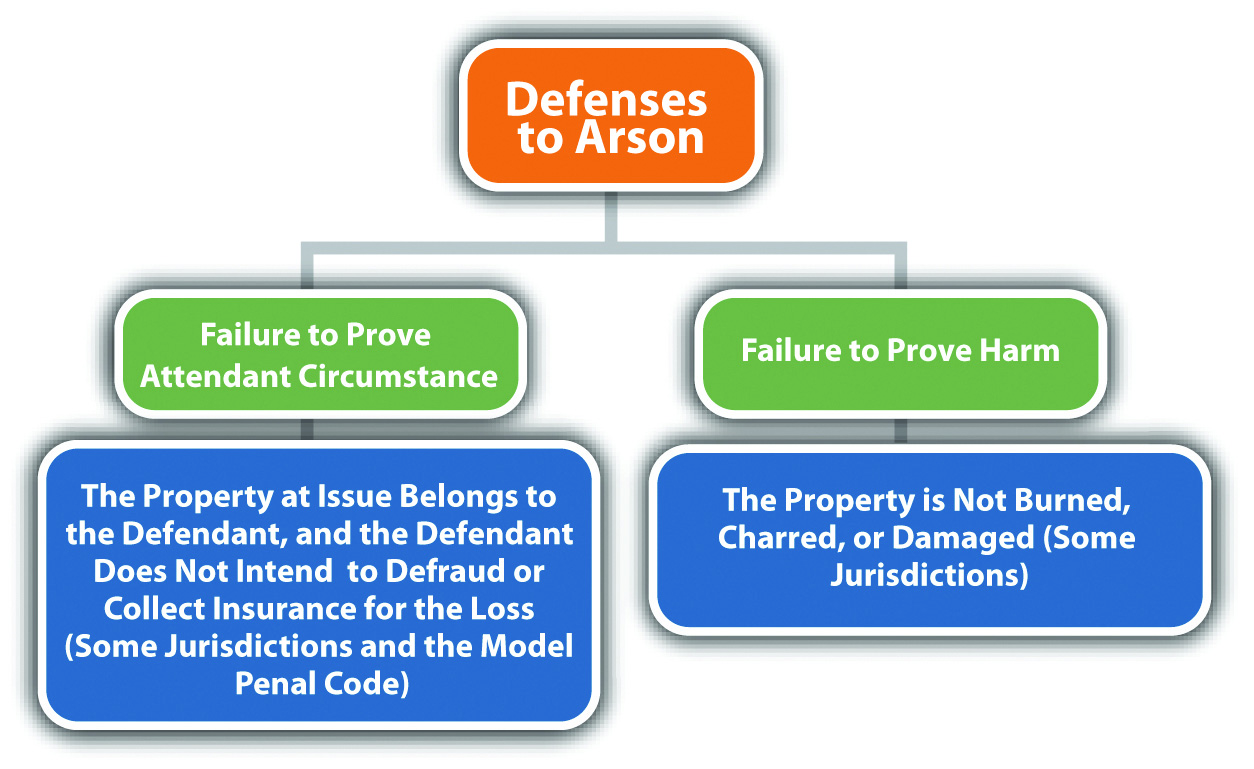
In most jurisdictions, arson must burn a specific type of property. Although this can be interpreted as an attendant circumstance, it is also a function of **grading**. Thus first-degree arson may focus on arson of a dwelling,Vt. Stat. Ann. tit. 13 § 502, accessed March 22, 2011, <http://law.justia.com/codes/vermont/2009/title-13/chapter-11/502>. while second-degree arson focuses on arson of other property.Vt. Stat. Ann. tit. 13 § 503, accessed March 22, 2011, <http://law.justia.com/codes/vermont/2009/title-13/chapter-11/503>. Many jurisdictions do *not* require the attendant circumstance that property “belongs to another,” and therefore the defendant can burn his or her own property and still be guilty of arson. However, the defendant must generally burn his or her property with the **specific intent** or **purposely** to *defraud* for the burning to constitute arson.Ga. Code tit. 16 § 16-7-62, accessed March 22, 2011, law\.onecle.com/georgia/16/16-7-62.html. The Model Penal Code requires “destroying or damaging any property, whether his own or another’s, to collect insurance for such loss” (Model Penal Code § 220.1(b)).

### Example of a Case Lacking Arson Intent for Burning the Defendant’s Property <a href="#example_of_a_case_lacking_arson_intent_for_burning_the_defendant.e2.80.99s_property-17532" id="example_of_a_case_lacking_arson_intent_for_burning_the_defendant.e2.80.99s_property-17532"></a>

Tim decides he wants to get rid of all the reminders of his ex-girlfriend. Tim piles all the photographs, gifts, and clothing items that are connected to his relationship with his ex into his fireplace and burns them. In this scenario, Tim probably does *not* have the criminal intent element required for arson in most jurisdictions. Although Tim burned or damaged property, the property belongs to *Tim*, not another. Thus Tim must burn the property with the **specific intent** or **purposely** to defraud—most likely an insurance carrier. Tim burned his own property with only **general intent** or **knowingly**, so Tim may not be charged with and convicted of arson in most jurisdictions.

### Arson Causation <a href="#arson_causation-17532" id="arson_causation-17532"></a>

The criminal act must be the **factual** and **legal cause** of arson harm, which Section 11 defines. As stated previously, the defendant does not have to *intend* to burn a specific structure or personal property, even if that is the end result in many jurisdictions. However, there must be a causation analysis in every arson case because arson is a crime that requires a bad result or harm. Thus the arson **harm** must be *reasonably foreseeable* at the time the defendant commits the criminal act with the accompanying criminal intent.

### Example of Arson Causation <a href="#example_of_arson_causation-17532" id="example_of_arson_causation-17532"></a>

Review the example with Clark and Manny in Section 11. In this example, Clark and Manny try to light a fire in the forest, but the grass is too damp, so they give up and leave the area. Hours later, a spark from their fire ignites, burning thousands of acres. Clark and Manny could be the **factual** and **legal cause** of this harm in many jurisdictions. Even though the grass was damp and difficult to burn, a trier of fact could find that it is reasonably foreseeable when lighting a fire in the forest that the fire could turn into a massive and destructive blaze. Thus Clark and Manny’s act accompanied by the general intent or knowingly to burn **caused** significant harm, and Clark and Manny may be subject to prosecution for arson in this case.

### Arson Harm <a href="#arson_harm-17532" id="arson_harm-17532"></a>

The **harm** element required for arson is burning, charring, or damage to the property specified in the arson statute. Damage could be damage to even a small part,California Criminal Jury Instructions No. 1515, accessed March 22, 2011, <http://www.justia.com/criminal/docs/calcrim/1500/1515.html>. and in the most extreme cases, even smoke damage without burning or charring is sufficient.*Ursulita v. State*, 706 S.E.2d 123 (2011), accessed March 22, 2011, [http://scholar.google.com/scholar\_case?case=8922319356856476558\&q= Ursulita+v.+State\&hl=en\&as\_sdt=2,5\&as\_ylo=2000](http://scholar.google.com/scholar_case?case=8922319356856476558\&q=Ursulita+v.+State\&hl=en\&as_sdt=2,5\&as_ylo=2000). The Model Penal Code only requires starting a fire or causing an explosion with the appropriate criminal intent, regardless of whether damage to real or personal property ensues (Model Penal Code § 220.1(1)). Some states follow the Model Penal Code approach.Tex. Penal Code § 28.02, accessed March 22, 2011, law\.onecle.com/texas/penal/28.02.00.html.

### Example of Arson Harm <a href="#example_of_arson_harm-17532" id="example_of_arson_harm-17532"></a>

Review the example with Clark and Manny in Section 11. In this example, Clark and Manny started a fire in the woods that burned a small circle of dead grass. This **damage** is probably sufficient to constitute the harm for arson in most jurisdictions. Although the value of the damaged forest land is not *excessive*, excessive damage is not typically a requirement under modern arson statutes—*any* damage is enough. Thus Clark and Manny may be subject to a prosecution for and conviction of this offense in most jurisdictions.

<figure><img src="https://biz.libretexts.org/@api/deki/files/8766/b67ead88bda6b2c5b6380475c170c13e.jpg?revision=1" alt="Flowchart outlining defenses to arson: Failure to Prove Affirmative Defense and Failure to Prove Harm, leading to no significant consequences."><figcaption><p>Figure 11.9 Diagram of Defenses to Arson</p></figcaption></figure>

### Arson Grading <a href="#arson_grading-17532" id="arson_grading-17532"></a>

Arson is typically divided into degrees,Ga. Code tit. 16 § 16-7-60, accessed March 21, 2011, law\.onecle.com/georgia/16/16-7-60.html. or simple and aggravated.Cal. Penal Code § 451.5, accessed March 22, 2011, <http://law.onecle.com/california/penal/451.5.html>. Factors that can elevate **grading** are the burning or damage of another’s dwelling,Ga. Code tit. 16 § 16-7-60, accessed March 21, 2011, law\.onecle.com/georgia/16/16-7-60.html. bodily injury or death,Connecticut Criminal Jury Instructions § 53a-111, accessed March 22, 2011, [www.jud.ct.gov/ji/criminal/part9/9.3-1.htm](http://www.jud.ct.gov/ji/criminal/part9/9.3-1.htm). extensive property damage, or damage to property of high value.Cal. Penal Code § 451.5, accessed March 21, 2011, <http://law.onecle.com/california/penal/451.5.html>. As stated previously, arson is a serious felony that can result in a sentence of life in prison and mandatory registration requirements similar to serious sex offenses.730 ILCS § 10, accessed March 21, 2011, <http://law.onecle.com/illinois/730ilcs148/10.html>. Arson is also generally a strike in states that have three strikes statutesCal. Penal Code § 1192.7, accessed March 21, 2011, <http://law.onecle.com/california/penal/1192.7.html>. and a predicate felony for first-degree felony murder.Cal. Penal Code § 189, accessed July 15, 2010, <http://law.onecle.com/california/penal/189.html> (accessed July 15, 2010). Many jurisdictions grade even simple arson or second or third-degree arson as a felony.Cal. Penal Code § 451, accessed March 22, 2011, <http://law.onecle.com/california/penal/451.html>. The Model Penal Code grades arson as a felony of the second degree (Model Penal Code § 220.1).

### Criminal Mischief <a href="#criminal_mischief-17532" id="criminal_mischief-17532"></a>

**Criminal mischief** prohibits damaging or destroying property, tampering with property, or deception or threat that leads to a loss of property. Although criminal mischief may be a felony in many jurisdictions, it is generally a less serious felony than arson, either because the defendant inflicts damage to property in a safer manner or because the criminal intent is less heinous. The **criminal act** element required for criminal mischief is damaging,Ala. Code § 13A-7-21, accessed March 24, 2011, law\.onecle.com/alabama/criminal-code/13A-7-21.html. destroying, interfering with,Or. Rev. Stat. § 164.365, accessed March 24, 2011, <http://law.onecle.com/oregon/164-offenses-against-property/164.365.html>. or tampering withAlaska Stat. § 11.46.480, accessed March 24, 2011, <http://law.justia.com/codes/alaska/2009/title-11/chapter-11-46/article-04/sec-11-46-480>. property. The criminal intent element required for criminal mischief varies, depending on the jurisdiction and the degree of the offense. The criminal intent could be **specific intent** or **purposely**, **general intent** or **knowingly**, **reckless**, or **negligent**.18 Pa.C.S. § 3304, accessed March 24, 2011, law\.onecle.com/pennsylvania/crimes-and-offenses/00.033.004.000.html. The **attendant circumstances** required for criminal mischief are typically committing the criminal act against the property of another (or property that is government owned) without victim consent or with no right or authorization.Alaska Stat. § 11.46.475, accessed March 24, 2011, <http://law.justia.com/codes/alaska/2009/title-11/chapter-11-46/article-04/sec-11-46-475>. The **harm** element required for criminal mischief is damage, destruction, or interference to property by fire, explosive, flood, or some other method, or interference with electricity, water, oil or gas,Alaska Stat. § 11.46.475, accessed March 24, 2011, <http://law.justia.com/codes/alaska/2009/title-11/chapter-11-46/article-04/sec-11-46-475>. or loss of property or money by deception such as causing the victim to purchase a worthless product.18 Pa.C.S. § 3304, accessed March 24, 2011, law\.onecle.com/pennsylvania/crimes-and-offenses/00.033.004.000.html. As stated previously, criminal mischief is often a *less serious* felony than arson and could also be graded as a gross misdemeanor or misdemeanor.18 Pa.C.S. § 3304, accessed March 24, 2011, law\.onecle.com/pennsylvania/crimes-and-offenses/00.033.004.000.html. Factors that could elevate **grading** of criminal mischief are the extent of the property damage and the severity of the defendant’s criminal intent.18 Pa.C.S. § 3304, accessed March 24, 2011, law\.onecle.com/pennsylvania/crimes-and-offenses/00.033.004.000.html. The Model Penal Code criminalizes criminal mischief when the defendant purposely, recklessly, or negligently damages tangible property of another by fire, explosives, or other dangerous means, purposely or recklessly tampers with tangible property of another so as to endanger person or property, or purposely or recklessly causes another to suffer pecuniary loss by deception or threat. The Model Penal Code grades criminal mischief as a felony of the third degree, misdemeanor, petty misdemeanor, or violation, depending on the extent of the damage or the criminal intent (Model Penal Code § 220.3).

<figure><img src="https://biz.libretexts.org/@api/deki/files/8767/7d7c129b6f6f0ec0144211537913eefd.jpg?revision=1" alt="Flowchart depicting crimes that invade and damage property: Burglary, Arson, Criminal Trespass, Criminal Mischief. Details on criminal intent and attendant circumstances are included."><figcaption><p>Figure 11.10 Diagram of Crimes That Invade or Damage Property</p></figcaption></figure>

### Exercises <a href="#exercises-17532" id="exercises-17532"></a>

* The criminal act element required for burglary is breaking and entering, just entering, or remaining.
* The criminal intent element required for burglary is typically the general intent or knowingly to commit the criminal act and the specific intent or purposely to commit a felony, any crime, or a felony, petty, or grand theft once inside the burglarized area.
* Burglary generally includes the attendant circumstances that the area entered is a structure, building, or vehicle belonging to another, or an occupied building or structure, or a dwelling. Modern jurisdictions have eliminated the requirement that the property belong to another and prohibit the defendant from burglarizing his or her own property. Some jurisdictions require a vehicle to be locked, and a few jurisdictions require the burglary to take place at nighttime.
* Burglary is typically graded as a felony that is divided into degrees. First-degree burglary is often a strike in jurisdictions that have three strikes statutes and a predicate felony for first-degree felony murder.
* Typically, criminal trespass is an unauthorized (attendant circumstance) entry or remaining (criminal act) into a building, occupied structure, or place as to which notice against trespassing is given, owned by another (attendant circumstance) with general intent or knowingly that the entry was unauthorized (criminal intent). Criminal trespass is generally graded as a felony, albeit a less serious felony than burglary, or a misdemeanor if the area trespassed is a place rather than an occupied building or structure.
* The criminal act element required for arson is starting a fire, burning, or damaging with fire or explosives specified real or personal property.
* The criminal intent element required for arson is the general intent or knowingly to commit the criminal act in many jurisdictions.
* Arson statutes can specify the attendant circumstance that the defendant burns a specific type of property, such as a dwelling or other real or personal property. In most jurisdictions, if the defendant burns his or her own property, the defendant must act with the specific intent or purposely to defraud, typically an insurance carrier.
* The harm element required for arson is burning, charring, damage, or, in the most extreme cases, smoke damage.
* Arson is typically graded as a felony that is divided into degrees. First-degree arson is often a strike in jurisdictions that have three strikes statutes and a predicate felony for first-degree felony murder. Arson could also carry a registration requirement like serious sex offenses.
* The elements of criminal mischief are damaging or destroying property, tampering with property, or deception or threat that leads to a loss of property (criminal act and harm) with specific intent or purposely, general intent or knowingly, recklessly, or negligently. Although criminal mischief may be a felony in many jurisdictions, it is generally a less serious felony than arson and in some jurisdictions it is graded as a gross misdemeanor or misdemeanor.

### Exercises <a href="#exercises-17532" id="exercises-17532"></a>

Answer the following questions. Check your answers using the answer key at the end of the chapter.

1. Why is burglary of a **dwelling** at **nighttime** generally graded higher than other burglaries?
2. Read *Butler v. Florida*, No. 1D08-0958 (Fla: Dist. Court of Appeals, 2009). In *Butler*, the defendant appealed his convictions for trespass and criminal mischief, based on the trial court’s failure to instruct the jury on the defense of **necessity**. The defendant claimed he broke into a residence because he was being chased and feared for his safety. Did the Court of Appeal of Florida reverse the defendant’s convictions? Why or why not? The case is available at this link: [http://scholar.google.com/scholar\_case?case=1710354491441564352\&q= burglary+%22necessity+defense%22\&hl=en\&as\_sdt=2,5\&as\_ylo=2000](http://scholar.google.com/scholar_case?case=1710354491441564352\&q=burglary+%22necessity+defense%22\&hl=en\&as_sdt=2,5\&as_ylo=2000).
3. Read *In the Matter of V.V.C.*, No. 04-07-00166 CV (Tex.: Court of Appeals, 2008). In *V.V.C.*, the Court of Appeals of Texas dismissed a minor’s adjudication for arson when he started a fire in the boy’s restroom of a middle school. What was the basis for the court’s dismissal? The case is available at this link: [http://scholar.google.com/scholar\_case?case=1784800980619654964\&q= arson+%22smoke+damage%22\&hl=en\&as\_sdt=2,5\&as\_ylo=2000](http://scholar.google.com/scholar_case?case=1784800980619654964\&q=arson+%22smoke+damage%22\&hl=en\&as_sdt=2,5\&as_ylo=2000).

#### LAW AND ETHICS <a href="#law_and_ethics-17532" id="law_and_ethics-17532"></a>

WikiLeaks: Should Exposure of Information Be Criminal?

Julian Assange, famous for his computer hacking skills, is the editor in chief of WikiLeaks, a whistleblower website. WikiLeaks has exposed documents and videos detailing the corruption in Kenya, Guantanamo Bay procedures, and the American involvement in the Afghan and Iraq wars, portions of which were classified **confidential** and **secret**.Raffi Khatchadourian, “No Secrets,” *New Yorker* website, accessed March 29, 2011, <http://www.newyorker.com/reporting/2010/06/07/100607fa_fact_khatchadourian?printable=true>. The *New York Times* published some of this information.Charlie Savage, “U.S. Prosecutors Study WikiLeaks Prosecution,” *New York Times* website, accessed March 29, 2011, [www.nytimes.com/2010/12/08/world/08leak.html?\\\_r=2\\\&partner=rss\\\&emc=rss](http://www.nytimes.com/2010/12/08/world/08leak.html?\\_r=2\\\&partner=rss\\\&emc=rss). Although WikiLeaks did not actually “leak” classified material (some of it was allegedly passed to WikiLeaks by a low-level US Army intelligence analyst), the US Department of Justice has launched a criminal investigation regarding the release, and US prosecutors are reportedly considering charges against Assange.Charlie Savage, “U.S. Prosecutors Study WikiLeaks Prosecution,” *New York Times* website, accessed March 29, 2011, [www.nytimes.com/2010/12/08/world/08leak.html?\\\_r=2\\\&partner=rss\\\&emc=rss](http://www.nytimes.com/2010/12/08/world/08leak.html?\\_r=2\\\&partner=rss\\\&emc=rss).

1. Do you think it is ethical to expose or publish “leaked” confidential and secret government information?
2. What is the difficulty in prosecuting a defendant for this type of publication?

Check your answers using the answer key at the end of the chapter.

#### WikiLeaks Video <a href="#wikileaks_video-17532" id="wikileaks_video-17532"></a>

*60 Minutes* Interviews Julian Assange

Julian Assange’s interview with *60 Minutes* is shown in the following video:


---

# Agent Instructions
This documentation is published with GitBook. GitBook is the documentation platform designed so that both humans and AI agents can read, navigate, and reason over technical content effectively. Learn more at gitbook.com.

## Querying This Documentation
If you need additional information that is not directly available in this page, you can query the documentation dynamically by asking a question.

Perform an HTTP GET request on the current page URL with the `ask` query parameter:

```
GET https://studies-de-jure.gitbook.io/learn/sourcebooks/criminal-law/11.4-crimes-that-invade-or-damage-property.md?ask=<question>
```

The question should be specific, self-contained, and written in natural language.
The response will contain a direct answer to the question and relevant excerpts and sources from the documentation.

Use this mechanism when the answer is not explicitly present in the current page, you need clarification or additional context, or you want to retrieve related documentation sections.